March 2025
Familiar Strangers
Museum BOZAR – Centre for Fine Arts, Brussel.
14 Mar‘25 → 29 July‘25
Curator: Joanna Warsza
Familiar Strangers. The Eastern Europeans from a Polish Perspective is an exhibition of contemporary art reflecting upon recent changes in Eastern Europe. It starts from the perspective of diasporas, minorities and those who make the public sphere richer, in a region long considered culturally homogeneous, even if it was never truly a case. Each of the rooms of the exhibition is inhabited by a different artist, presenting paintings, sculptures, videos, films, installations, and textiles, gathering over 40 works by 13 artists, most of which are shown in Belgium for the first time. In a highly turbulent period for Europe, the exhibition explores how social and political struggles intertwine with personal stories. Familiar Strangers calls for the necessity of a Europe in which we see and hear each other for who we really are, with and despite our differences. Curated by Joanna Warsza, an international curator currently a city curator of Hamburg and features works by Oliwia Bosomtwe, Assaf Gruber, Zuzanna Hertzberg, Renata Rara Kamińska, Jasmina Metwaly, Małgorzata Mirga-Tas, Ngo Van Tuong, Open Group, Janek Simon, Shadow Architecture, Jana Shostak and Mikołaj Sobczak.

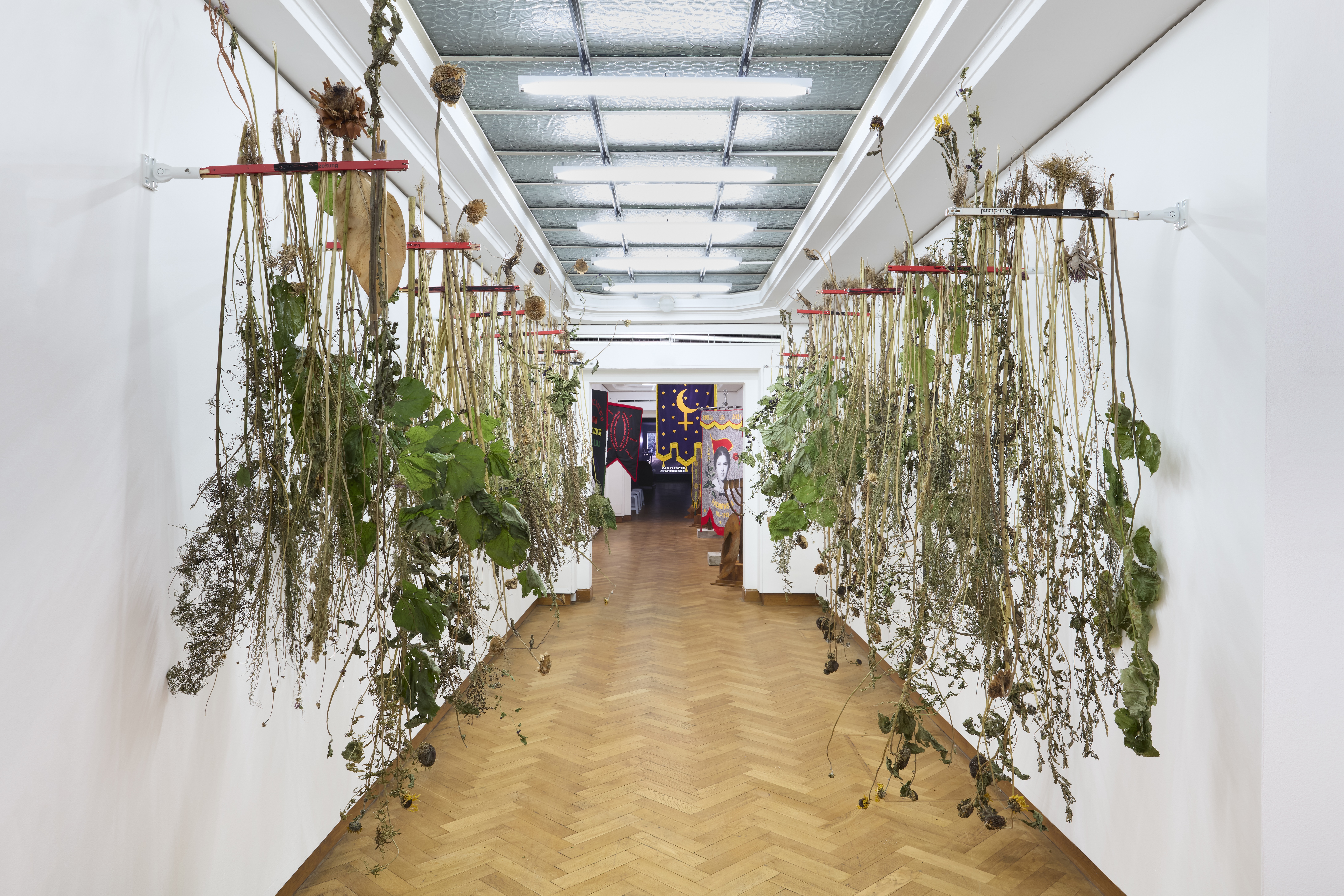
MIEDZA – Renata Rara Kaminska
Commissioned by Bozar – Centre for Fine Arts, Brussels
Courtesy of the artist
Installation, 2025 ca. 1450 x 550 x 450 cm
“Do you know, sometimes I have the feeling that I am not a real human being, but some kind of bird, or another animal in human form. Inside, I feel far more at home in a little scrap of garden like this, or in a field among bumblebees and grass than at a party conference.” – Róża Luxemburg, Letters from Prison, 1917. Róża Luxemburg (1871-1919) is best known as an internationalist, an anti-imperialist, and a Marxist revolutionary. She has been considered a key figure in Germany’s anti-war and socialist movements from the late 19th and early 20th century. She is, however, less recognised as a Polish Jew and a passionate self-taught botanist. Since the end of the Communist era, Luxemburg’s legacy in Eastern Europe has been obscured and forgotten, also because she considered nationalism as a violent tendency. Artist Renata Rara Kaminska (lives in Berlin), who shares Luxemburg’s birthplace, the city of Zamosc has devoted a number of artworks to the revolutionary. The installation presented here refers to Luxemburg’s herbariums made during her years in prison in Wrocław shortly before her death. The herbarium becomes the garden Luxemburg always wished for and never managed to have. Miedza is full of dried flowers, weeds and wild plants that Luxemburg, and the artist after her, have been collecting such as thistles, nettles or trefoils. They pay tribute to the act of growing despite all odds, refusing to be unnecessary, keeping on going. Wild plants, which are often considered as uninvited guests, can in fact be essential in healing processes and stubborn in the will to grow. Something Róża Luxemburg always looked for, both in forests and in politics.
January 2025
Foundation Matthäus
24 – 2 = 2022
double solo show with Alevtina Kakhidze
10.01.2025-10.03.2025
Foundation Matthäus, Berlin
Curator: Hannes Langbein
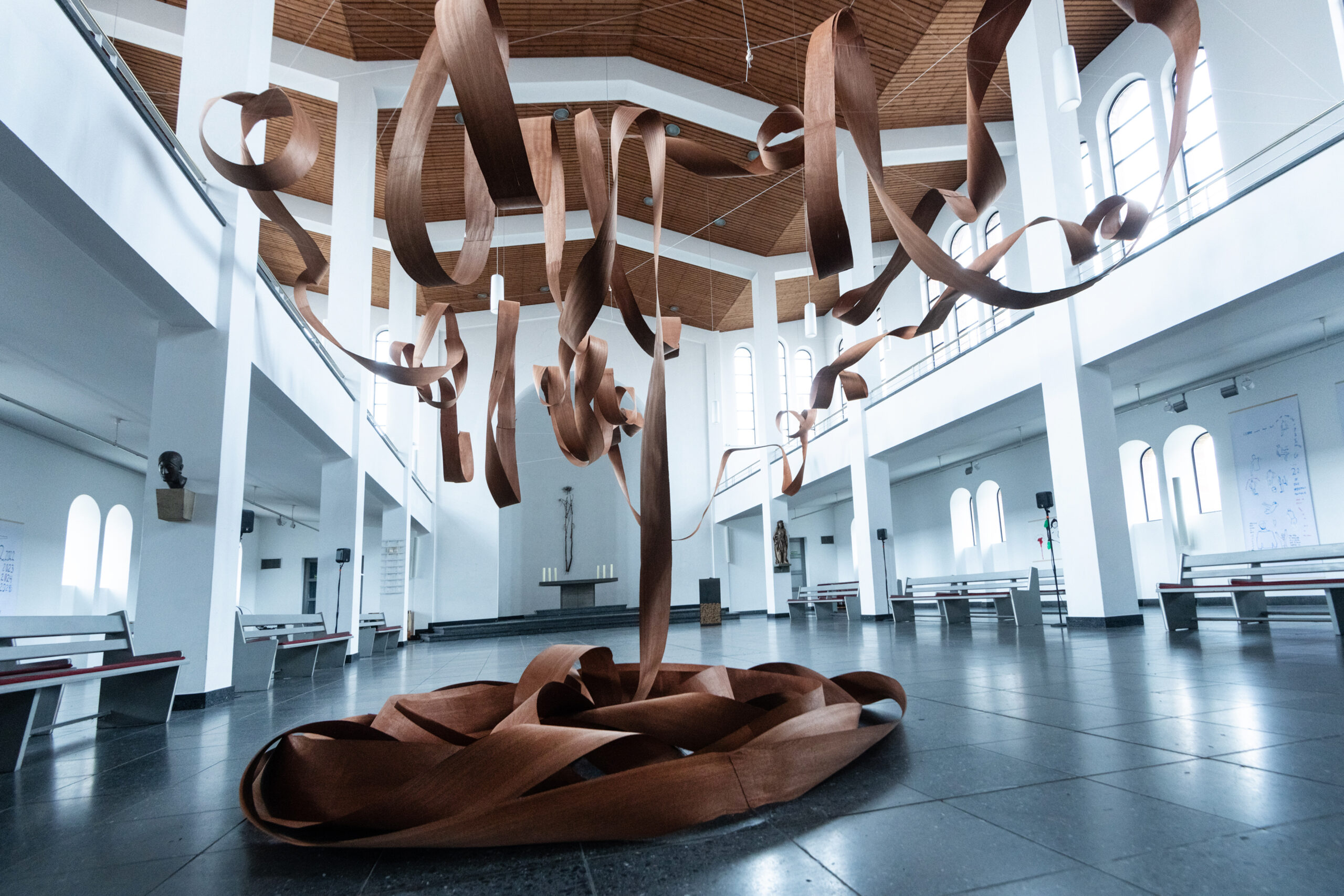
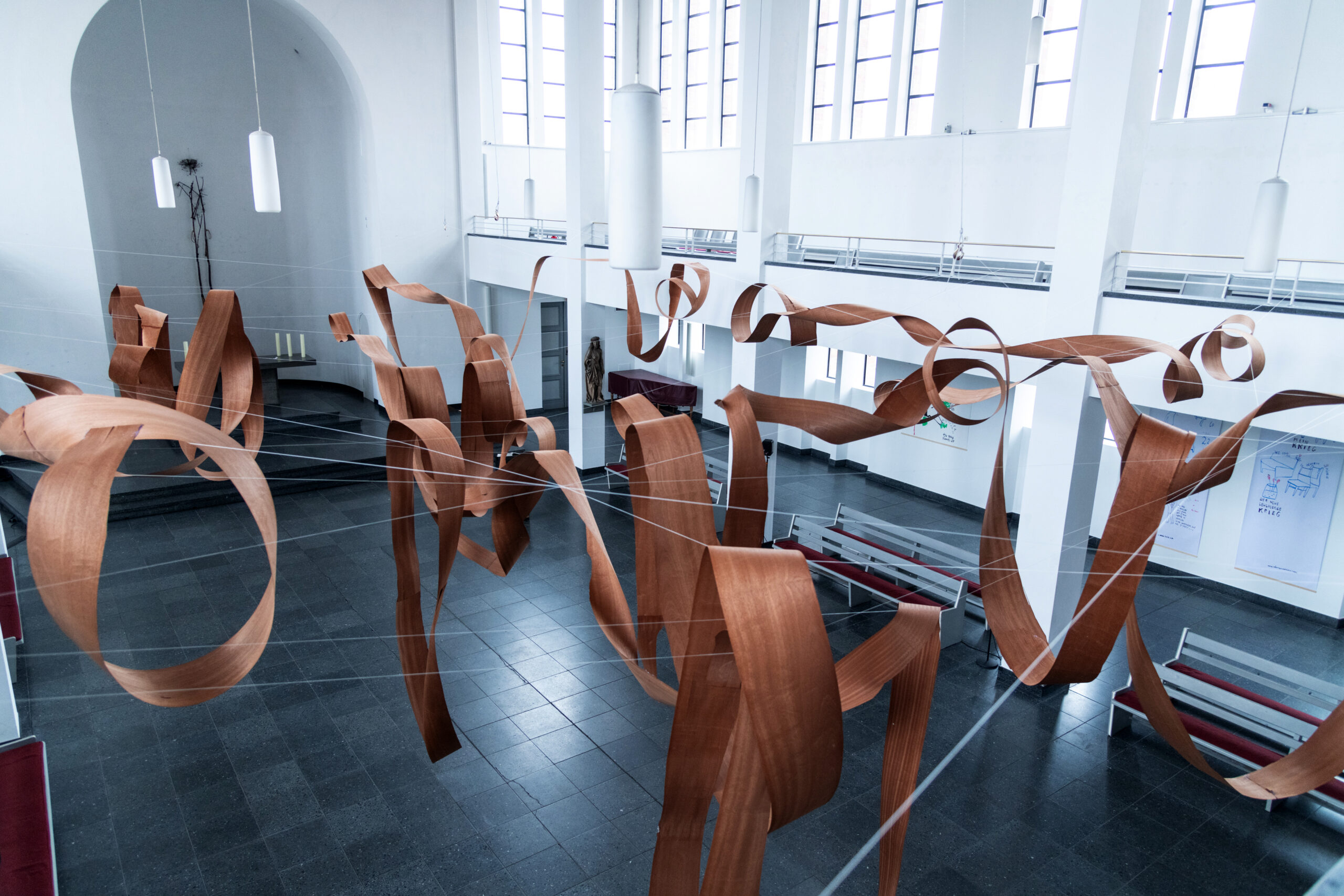
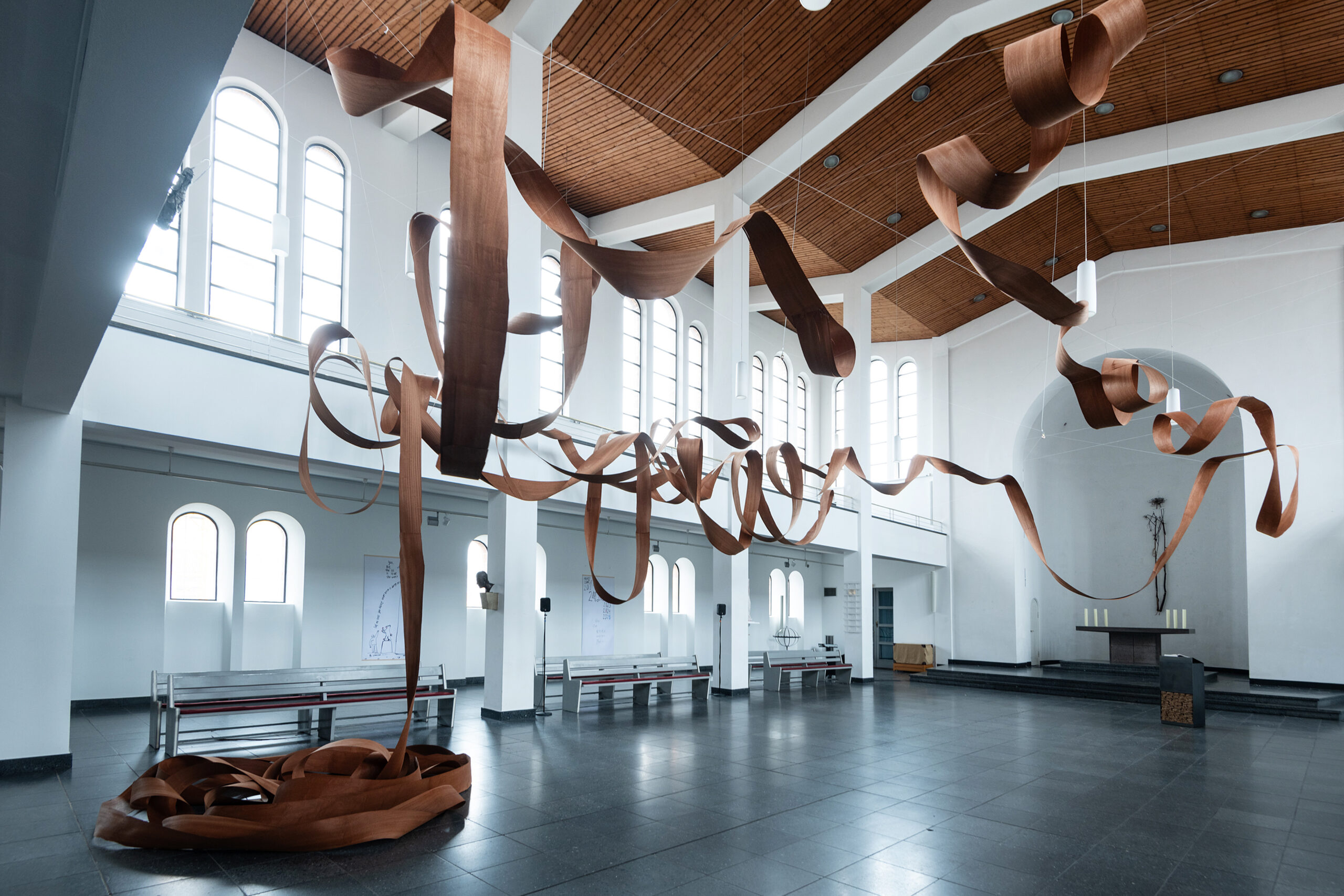
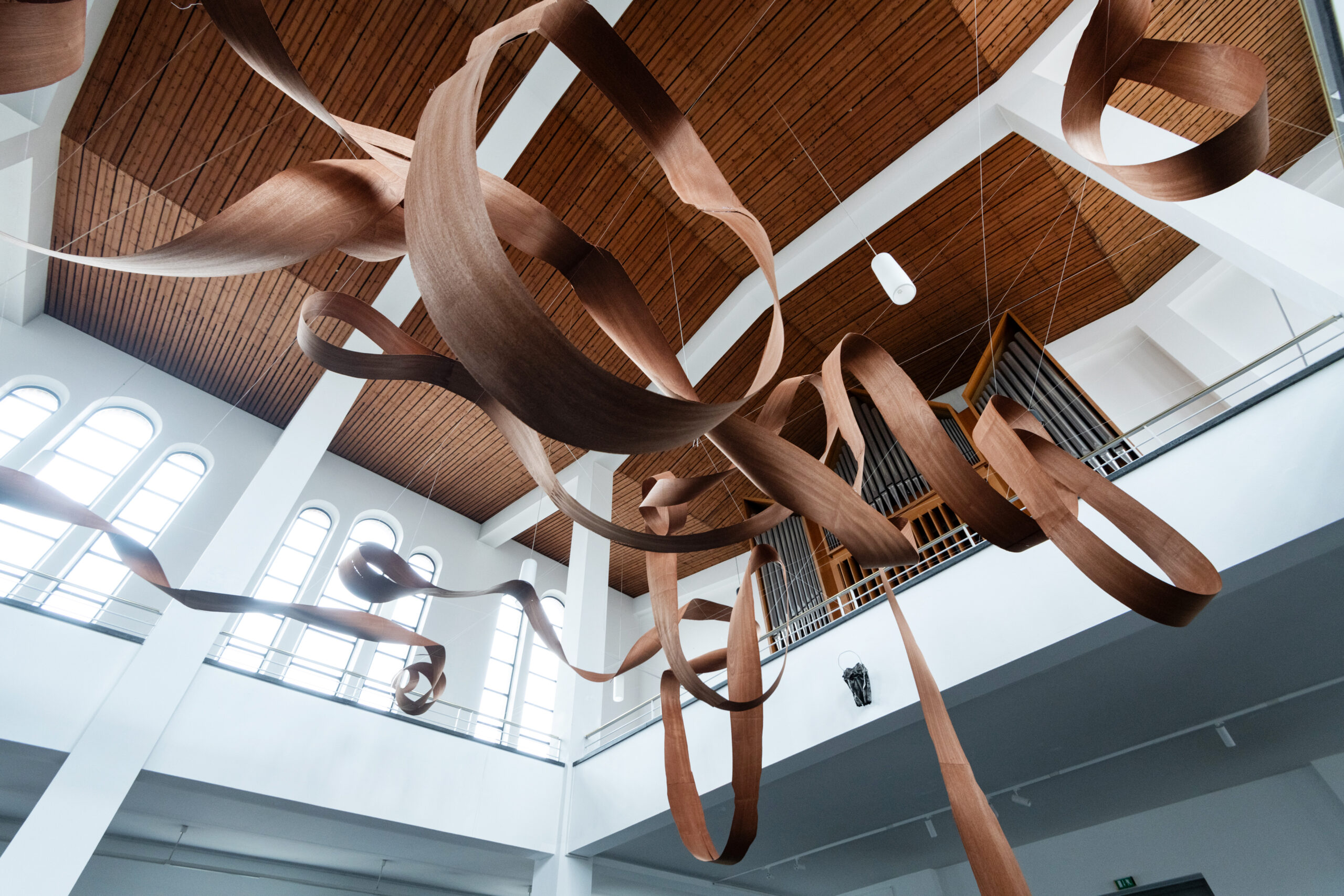
N/AER – Renata Rara Kaminska
Indoor sculpture, 2025, Vintage mahogany, silicone, 1400 x 700 x 600 cm
In the exhibition, Renata Rara Kaminska explores the theme of colonialism. She works with sculptural objects made from thin strips of veneer from rare African tree relics. The metaphor of man-made changes to ecosystems not only touches on questions of nature conservation, which are inherent to the discourse of the Anthropocene, but also political strategies of resistance against the actions of empires. installation, fine veneers made from tropical precious woods – phantom sculptures made from veneer for luxury furniture. The history of the material from which the sculptures are made is fascinating. Kaminska acquired the veneer from the family of one of the last German colonisers who lost their African land after World War I. The veneer, made from African mahogany, was on board one of the last ships that brought colonial goods to Hamburg in the 1910s and was then stored for about a century. The trees used for this veneer are still barbarically cut down in African, Asian and South American countries even though they are relicts and listed in the Red Book. Interestingly, similar veneer can be bought here as well as worldwide. Mahogany phantom objects are a reminder of the lost harmony between man and nature, the equality of peoples and biological species. Latent traits of colonialism are insidiously manifesting themselves in various areas of our lives. The abstract ‘scraps’ of red wood are a gesture that invites everyone to reflect on fundamental questions that can help to develop a strategy for restoring the delicate balance between the natural and the political, the civilisational and the ecological, ultimately on a local and global level. Colonialism in all its forms is a global phenomenon that has shaped and continues to shape policies and practices not only in Asia, Africa and the Americas, but also on the Eurasian continent. The colonial legacy and deep-rooted injustice continue to shape human and non-human ways of life on our planet, and the history and legacy of the Russian Empire and the Soviet Union should redefine our perspective from a post-colonial perspective. Colonialism and coloniality are not relics of the past: both phenomena continue to influence and shape every aspect of life on our planet today. And finally, how do we imagine our common future? What comes after the empire, after the ‘post-Soviet’ and after the collapse of nature?
Artist:
Alevtina Kakhidze
Renata Rara Kaminska
Curator:
Hannes Langbein
Cooperation:
Prof. Dr. Jörg Heiser
Kim Brian Dudek
Dr. Kateryna Rietz-Rakul
Partners:
Ukrainian Institute Germany, Polish Institute Berlin, Foundation for German-Polish Cooperation